Which shaft couplings are truly zero backlash?
Disc, bellows, slit, high-gain rubber and rigid couplings are zero-backlash by construction: torque passes through a continuously elastic or solid element, with no clearance between mating parts. Oldham and serration types are not. Jaw couplings are zero-backlash only below a stated torque limit.
Why backlash is not a tolerance you can compensate
In a positioning axis, the encoder usually sits on the motor. Backlash in the coupling lives between the encoder and the load, so the control loop cannot see it: the motor reports that it has arrived while the load is still a few arc-minutes behind. On reversal, the error changes sign. No amount of gain, feedforward or filtering removes it, because the information never reaches the controller.
That is why NBK calls a zero-backlash type essential for motion control rather than merely desirable. The couplings that qualify all share one trait: torque is transmitted through a member that is elastically continuous — a stack of steel disks, a metal bellows, a slit cylinder, a moulded rubber body — instead of through parts that touch with clearance.
Torsional stiffness and torque, series by series
| Series | Construction | Torsional stiffness (N·m/rad) | Rated torque (N·m) |
|---|---|---|---|
| XHS-C | Disc, single | 110 – 52,000 | 0.6 – 280 |
| XHW-C | Disc, double | 100 – 47,000 | 0.6 – 280 |
| MSX | Slit, A7075 | 200 – 5,100 | 0.5 – 9 |
| MST | Slit, A2017 | 25 – 3,100 | 0.1 – 32 |
| XGT2-C | High-gain rubber (FKM) | 110 – 2,500 | 1.1 – 35 |
| XUT-C | Cross joint | 200 – 2,300 | 0.3 – 6 |
| MFBS | Bellows, SUS316L | 100 – 490 | 0.5 – 3 |
| MSF | Serration (not zero-backlash) | 4.4 – 52 | 0.5 – 3 |
Ranges span the smallest to the largest size in each series. Source: NBK product catalogue, section “Shaft couplings”, p. 69–70, 75–76, 101–102, 109–110, 39–40, 159–160, 199–200, 205–206.
Single disc or double disc? You are trading stiffness for alignment tolerance
The XHS (single disk) and the XHW (double disk, with a spacer) carry the same rated torque — 0.6 to 280 N·m across sizes 15C to 98C — and cost roughly the same. The difference is in two columns.
The XHS is stiffer: up to 52,000 N·m/rad against 47,000 for the XHW. But it tolerates only 0.01 to 0.02 mm of lateral misalignment, where the XHW takes 0.1 to 0.5 mm — an order of magnitude more. Angular capacity halves too: 0.7–1° against 1.4–2°.
So the choice is not “which is better” but “how well can you align”. A single-disc coupling on a hand-shimmed motor mount is a coupling that will fail early from lateral load. If the mounting is machined and doweled, the XHS gives you the highest torsional stiffness in the range. If it is bolted and adjusted on site, take the XHW — and if you need more lateral capacity than that, the XHW-L variant raises it again at the same stiffness (a 39C goes from 0.25 mm to 0.4 mm lateral while both stay at 4,700 N·m/rad).
The surprise: the stiffest coupling is not the best servo coupling
The classical argument for disc couplings is torsional rigidity: a stiff coupling raises the mechanical resonance, which lets you raise the servo gain, which shortens settling time. True — up to the point where the resonance the coupling does have starts to ring.
NBK measured it. Driving the same axis at increasing servo gain, the XG2 high-gain rubber coupling, the older XG, and a disc coupling behave identically at gain 25 (12 ms settling). At gain 27 the disc coupling starts hunting — oscillating around the target instead of settling — while both rubber types still settle in 8 ms. At gain 32 only the XG2 is still stable, settling in 3 ms; the XG hunts too.
The rubber body damps the resonance instead of merely being stiff, and damping is what lets the loop be turned up. That is the reasoning behind NBK’s own recommendation to prefer high-gain rubber over disc for modern servomotors.
Settling behaviour at rising servo gain
| Servo gain | XG2 series | XG series | Disc type |
|---|---|---|---|
| 25 | 12 ms settling | 12 ms settling | 12 ms settling |
| 27 | 8 ms, 0.6 µm overshoot | 8 ms, 1 µm overshoot | Hunting occurs |
| 32 | 3 ms, 1.7 µm overshoot | Hunting occurs | Hunting occurs |
NBK’s measurement, same axis, gain raised step by step. Source: NBK product catalogue, section “Shaft couplings”, p. 27–28, and the XG-series leaflet.
And when the environment decides instead
Zero backlash narrows the field; the environment often picks the winner inside it.
- Encoders and measuring axes — bellows. NBK: “revolution at constant speed can be achieved even in the presence of misalignment.” Torque is modest (MFB 0.3–2 N·m; the stainless MFBS 0.5–3 N·m) because an encoder needs fidelity, not force.
- Vacuum and cleanroom — the slit coupling in SUS316L (XSTS, 2–35 N·m) or the PEEK MSXP (0.7–1.5 N·m), which also gives electrical insulation of 2 MΩ or more.
- Heat — the Oldham MOHS with its VESPEL spacer runs to 200 °C, but at 900 min⁻¹ only; the PEEK MOP runs to 120 °C.
- Electrical insulation — most series give 2 MΩ or more between hubs. The exception is worth remembering: the XGT2 in the largest ⌀68 size, and the whole HNBR XGT/XGL/XGS family, are specified at 10 kΩ to 1 MΩ. If insulation is a requirement, that is not the same product.
The zero-backlash shortlist
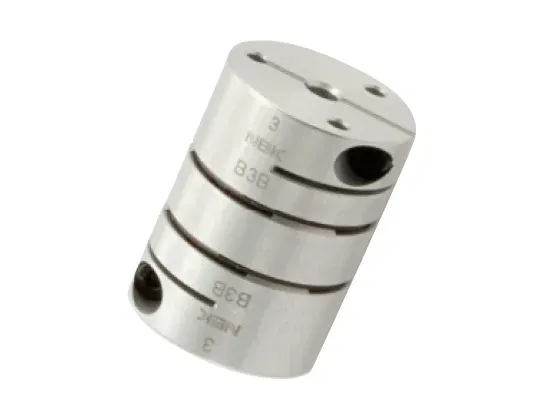
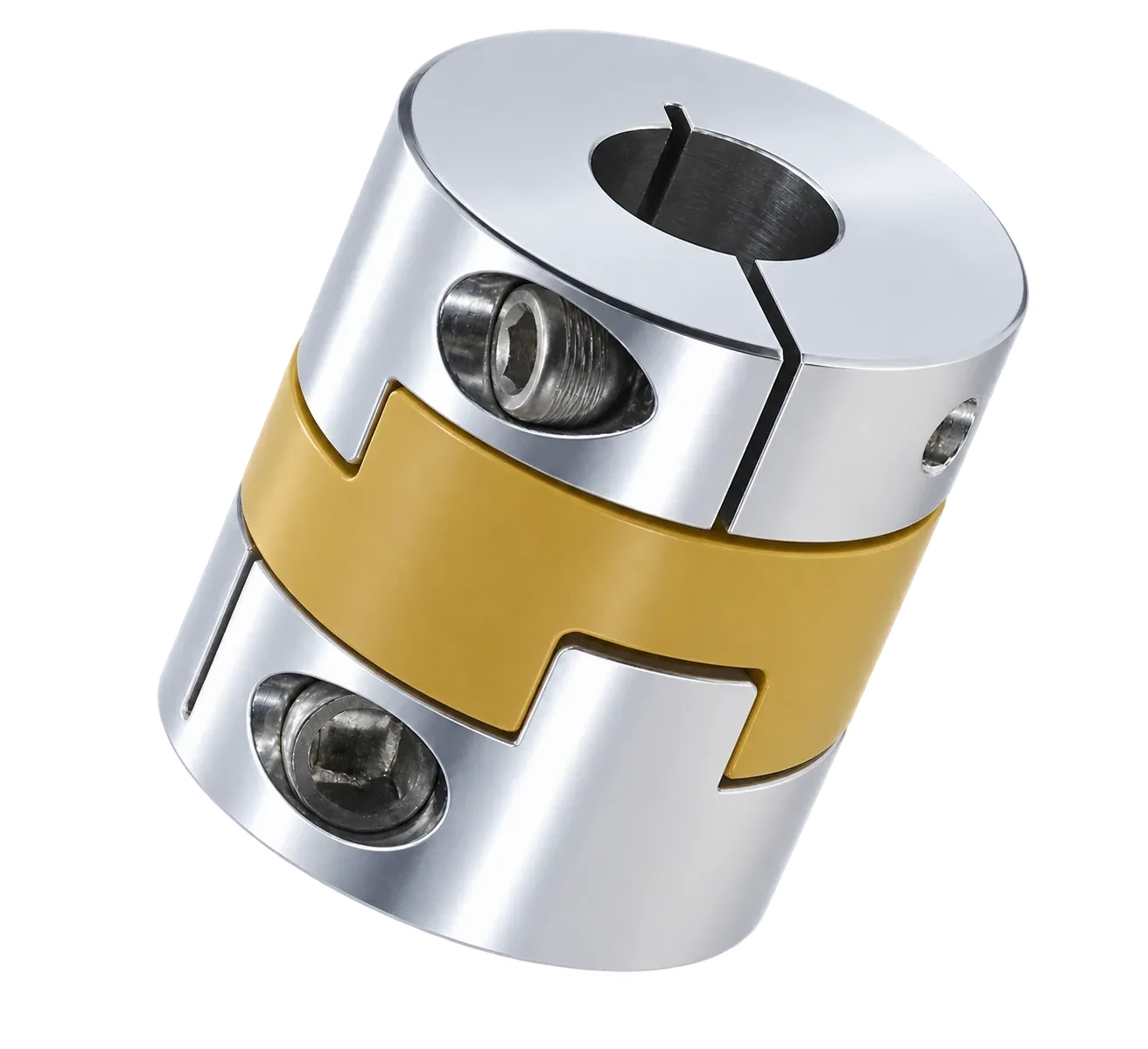
Backlash-Free Disc Flexible Coupling (XHW · XHS · XHW-L)
Zero-backlash stainless-steel disc coupling with very high torsional stiffness for high-speed, high-precision servo and stepper positioning.
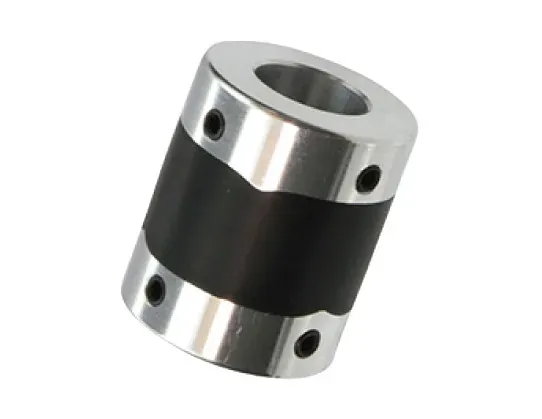
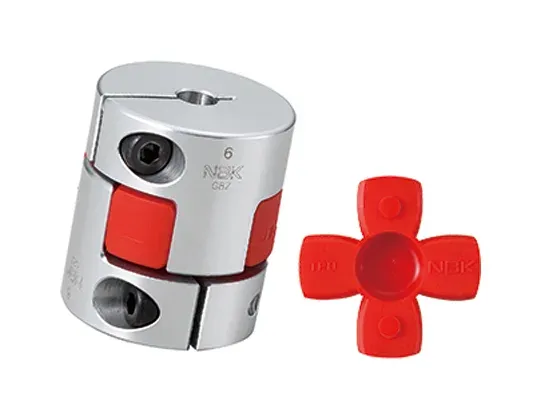
High-Gain Rubber Coupling (XGT · XGL · XGS)
Zero-backlash elastomer coupling that combines high torsional stiffness with superior vibration and shock damping, ideal for dynamic servo drives.
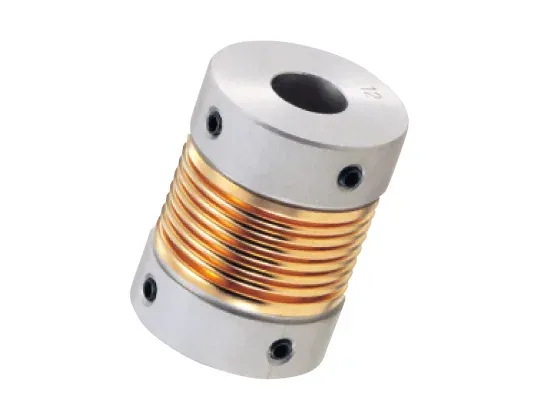
Metal Bellows Flexible Coupling (MFB · MFBS)
Thin-walled metal bellows coupling for exceptional positioning accuracy: zero backlash and constant-velocity rotation with very low reaction forces on bearings.
Not sure which one your machine needs?
Send us the torque, speed, misalignment and environment. Our engineers come back within 24 hours with a concrete recommendation — and a sample if you want to test it.