Which flexible coupling works at high temperature?
Check NBK’s allowable operating temperature first: standard jaw and serration couplings are rated −20 to 60 °C, most rubber and resin types to 80 °C, and the high-gain rubber types XGT2/XGL2/XGS2 to 120 °C. For hotter machines NBK builds a dedicated cleanroom/vacuum/heat-resistant family: all-stainless slit couplings XSTS and XWSS, the PEEK slit type MSXP (−20 to 80 °C) and the Oldham types MOP (PEEK spacer, −20 to 120 °C) and MOHS (VESPEL spacer, −20 to 200 °C). Above 30 °C ambient, also multiply the rated torque by NBK’s temperature correction factor.
Why temperature is the first limit — not torque
NBK’s couplings basics brochure is precise about where the temperature limit comes from: “The allowable operating temperatures of the couplings that use rubber/resin are as shown in the table below.” The limit is a property of the polymer element — the elastomer sleeve of a jaw coupling, the rubber body of a high-gain coupling, the resin spacer of an Oldham. The metal hubs are not the weak point.
That single sentence explains the whole table. A jaw coupling ends at 60 °C because its sleeve does. The high-gain rubber types XGT2/XGL2/XGS2 reach 120 °C because their rubber compound is rated for it. And the all-metal types — slit, disc, bellows, rigid — do not appear in the table at all, because they have no rubber or resin element to fail first.
Heat does three more things before any material actually fails. It lowers the torque a coupling may transmit (NBK’s correction factor starts at 30 °C — see below). It changes torsional stiffness: NBK plots this per series, and for the heat-resistant XSTS, XWSS and MOP types the published change is small, so servo responsiveness barely shifts. And it moves your shafts: thermal elongation and deflection increase the misalignment the coupling has to absorb — NBK prints an explicit caution about exactly this in the heat-resistant series’ technical information.
NBK’s allowable operating temperatures (rubber/resin element series)
| Product code | Coupling type | Allowable operating temperature |
|---|---|---|
| MOHS | Oldham, VESPEL spacer | −20 to 200 °C |
| MOP | Oldham, PEEK spacer | −20 to 120 °C |
| XGT2 (OD ≤ 56 mm) · XGL2 · XGS2 | High-gain rubber | −10 to 120 °C |
| XGT2 (OD 68 mm) · XGT · XGL · XGS | High-gain rubber | −20 to 80 °C |
| MSXP | Slit, PEEK body | −20 to 80 °C |
| MOC · MOR · MOL · MOS | Oldham | −20 to 80 °C |
| MJC · MJS · MJB | Jaw | −20 to 60 °C |
| MSF | Serration | −20 to 60 °C |
NBK publishes this table only for couplings with a rubber/resin element; all-metal types such as the SUS316L slit couplings XSTS/XWSS carry no such numeric limit. Source: Couplings Basics Brochure (2026 edition), p. 87.
The cleanroom / vacuum / heat-resistant family: two constructions
For machines that combine heat with vacuum, cleanroom or chemical exposure — FPD and semiconductor manufacturing equipment are NBK’s own reference applications — NBK builds a dedicated family with two very different constructions.
All-metal slit couplings (XSTS-C, XWSS-C). A single piece of SUS316L with a machined slit pattern that acts as a plate spring: zero backlash, no separate wearing parts, nothing polymeric to age in the heat. NBK notes that SUS316’s molybdenum addition gives it high-temperature strength — it is used as a heat resistant steel — and the published change in torsional stiffness with temperature is small. The couplings are shot-blasted, ultrasonically cleaned, cleanroom washed and packed, and excel at chemical and corrosion resistance. The high-flexibility XSTS-C accepts eccentricity, angular misalignment and end-play; the short XWSS-C trades misalignment capacity for compactness.
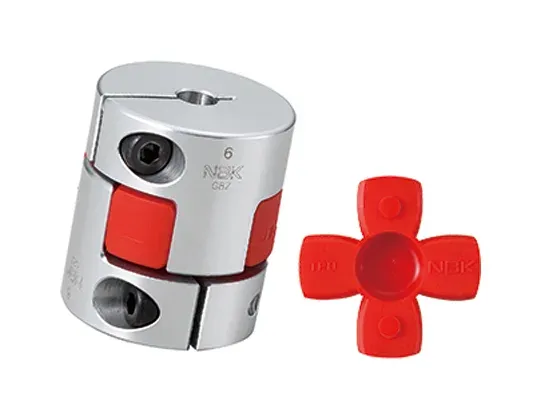
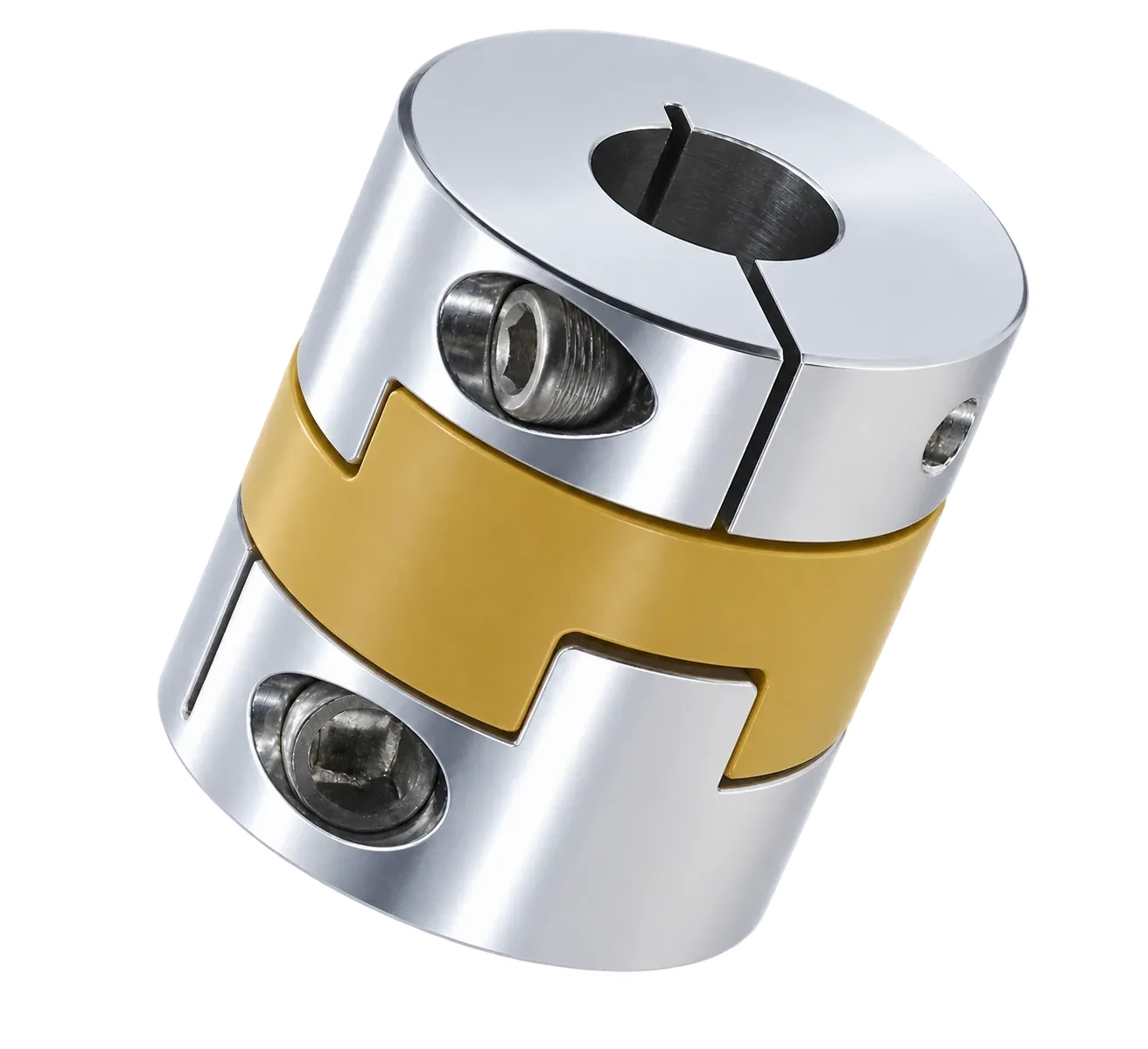
Oldham couplings with a high-performance polymer spacer (MOP-C, MOHS-C). Here the polymer is chosen for the heat instead of avoided: MOP-C pairs A2017 aluminium hubs with a PEEK spacer and is rated −20 to 120 °C; MOHS-C pairs SUS303 stainless hubs with a VESPEL SCP-5000 spacer and reaches −20 to 200 °C. Both offer the Oldham virtues — high allowable misalignment, low load on the shaft, excellent electrical insulation — and both are cleanroom washed and packed. NBK’s outgas analysis for this construction found both inorganic and organic gases below the lower determination limit, measured with the test products heated to 100 °C.
The honest trade-off between the two constructions: the slit types are the low-particle choice (NBK rates them “excellent” for low particle generation), while the Oldham types may produce abrasion powder as hubs and spacer slide — NBK marks this openly in the property table. Positioning accuracy differs too: the slit types are zero-backlash, the Oldham types are not.
The heat-resistant family at a glance
| Series | Construction & material | Allowable operating temperature | Distinguishing property |
|---|---|---|---|
| MOHS-C | Oldham; SUS303 hubs, VESPEL SCP-5000 spacer | −20 to 200 °C | Highest temperature in the range; high misalignment; electrical insulation |
| MOP-C | Oldham; A2017 aluminium hubs, PEEK spacer | −20 to 120 °C | High misalignment; electrical insulation; ultra-low outgas |
| XSTS-C · XWSS-C | One-piece slit type, all SUS316L | No polymer element — no numeric limit published | Zero backlash; best corrosion and chemical resistance; low particle |
| MSXP-C | One-piece slit type, PEEK body and screws | −20 to 80 °C | Zero backlash; electrical insulation; extremely low outgas |
All four series are cleanroom washed and packed and rated for cleanroom, vacuum and heat-resistant use. Sources: NBK datasheets for the XSTS/XWSS/MSXP slit series and the MOP/MOHS Oldham series.
Selecting for a hot machine, step by step
1. Establish the temperature at the coupling, not the room. Inside an enclosure, next to a process chamber or above a heater, the coupling sees more than the ambient figure on the datasheet of the machine. That number decides which series are even candidates.
2. Choose the construction from the motion task. Servo or stepper positioning needs zero backlash: the slit types XSTS/XWSS (metal) or MSXP (PEEK, insulating). Larger misalignment, electrical insulation or the full 200 °C: the Oldham types MOP/MOHS — accepting that they are not zero-backlash and may shed abrasion powder. Up to 120 °C without cleanroom or vacuum requirements, the standard XGT2/XGL2/XGS2 high-gain rubber types remain the servo choice.
3. Size on corrected torque. Select so the continuous load torque stays below rated torque multiplied by the temperature correction factor. For Oldham types, remember NBK’s printed assumption: the ratings apply with no load fluctuation and one direction of rotation — size up if your application reverses.
4. Budget extra misalignment. NBK’s general rule is to design at or below one third of the allowable misalignment, and to halve every allowable value when two or more forms occur together. In a hot machine, add the misalignment that thermal elongation and deflection of the shafts will create between cold start and steady state.
5. Match the environmental extras. If the application is also cleanroom, vacuum or chemical, this family covers it: cleanroom washing and packing, low outgassing and chemical resistance are part of the specification, not options bolted on.
The series to shortlist for heat
Zero-backlash stainless slit, high-misalignment Oldham to 200 °C, or high-gain rubber to 120 °C — start with these three.
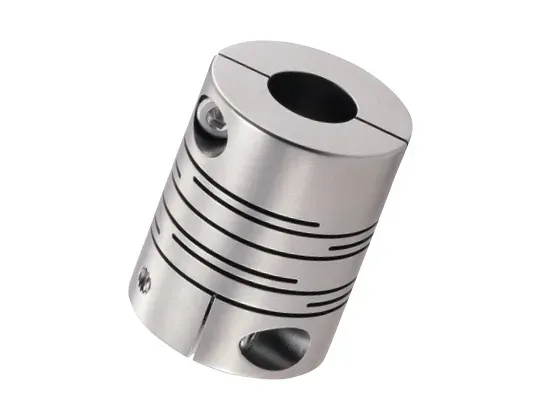
Slit Coupling for Cleanroom & Vacuum (XSTS · XWSS · MSXP)
One-piece slit couplings for cleanroom, vacuum and heat-resistant use: zero backlash, low particle generation and excellent chemical and corrosion resistance.
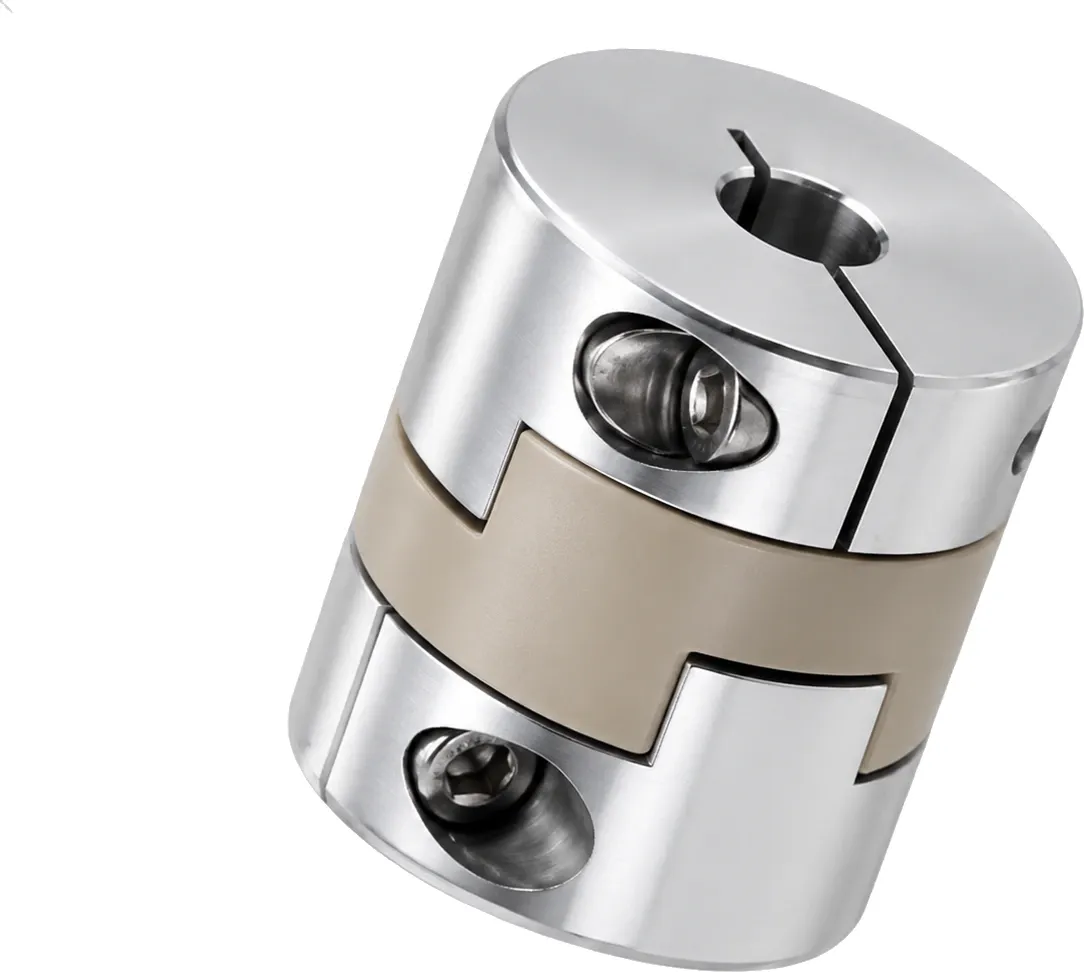
Oldham Coupling for Cleanroom & Vacuum (MOP · MOHS)
Heat-resistant, chemical-proof Oldham couplings with PEEK or VESPEL spacers for cleanroom and vacuum use: high misalignment tolerance and electrical insulation.
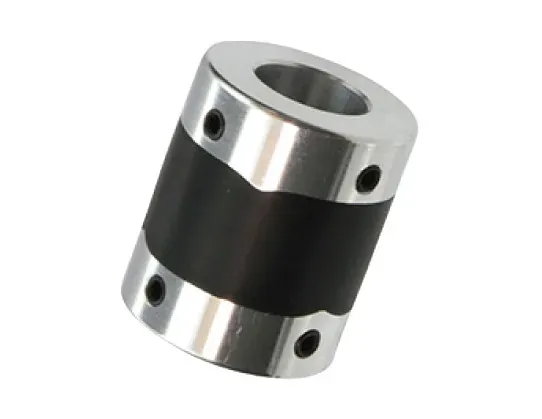
High-Gain Rubber Coupling (XGT · XGL · XGS)
Zero-backlash elastomer coupling that combines high torsional stiffness with superior vibration and shock damping, ideal for dynamic servo drives.
Not sure which one your machine needs?
Send us the torque, speed, misalignment and environment. Our engineers come back within 24 hours with a concrete recommendation — and a sample if you want to test it.